
Core concepts
Use this section when you want background on how PhenoMe represents phenotyping: embeddings, channel handling, distances, metadata, and what gets stored in results. You can install, run the Getting started workflow, and read the Learning paths without it; come back here when terminology in other pages needs a fuller explanation.
What is phenotyping?
Section titled “What is phenotyping?”Phenotyping characterizes the observable traits of biological samples. In microscopy this means analyzing cell shape (morphology), where proteins are located (fluorescence patterns), or how structures change under treatment.
PhenoMe automates this with deep learning. It is model-agnostic (it works with almost any vision model) and dataset-agnostic (it does not care how your files are organized).
Processing flow
Section titled “Processing flow”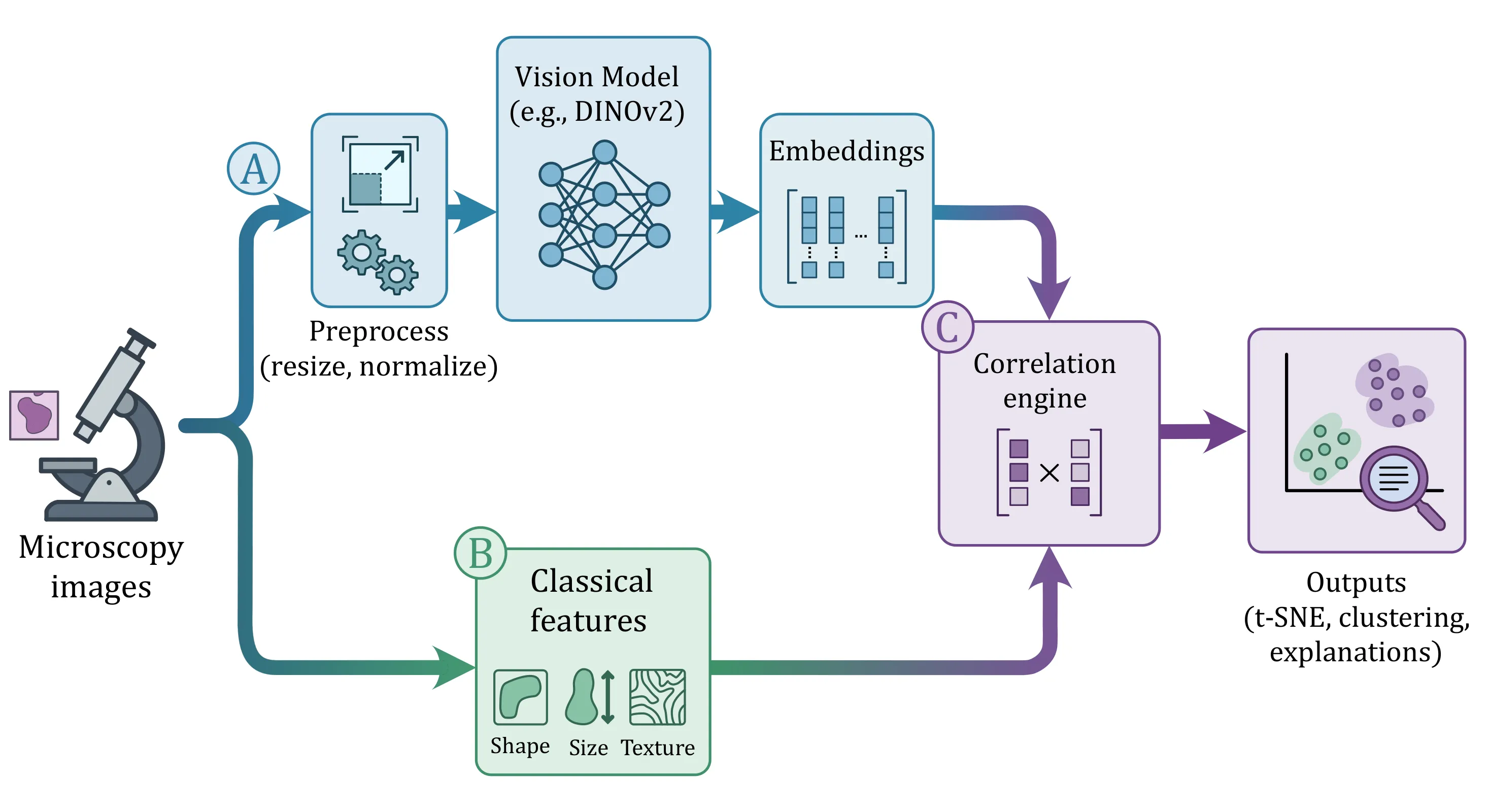
PhenoMe processes data through a bifurcated 4-step pipeline:
- Discovery (Input) — Discover images and extract experimental metadata.
- Embeddings (A) — Load images, apply transforms, and extract deep learning embeddings.
- Properties (B) — Compute interpretable classical features (shape, texture, intensity) in parallel.
- Analysis & Visualization (C) — Integrate both sources to quantify phenotypic distances and produce interactive plots.